In “Design as Critique” (chapter 3 of Speculative Everything) Anthony Dunne and Fiona Raby explore the use to Design to “jolt people out of their cosy complacency” by offering them an alternative to current realities.
In my last two blog posts I’ve discussed the value of a shift in mindset to identify and address emerging and changing needs in the post-industrial world. Some of my earliest explorations of this concept came through Edward de Bono’s writings on the Logic of Provocation and the creation of a Provocation Operation (or “PO”) as a signal the a statement is being used for its ability to shift people from an entrenched path of thinking to a side track as an essential step in creative generation. In “Design as Critique” Dunne & Raby delve into to the use of design as a way to challenge path determinant thinking and engage with an alternative for how things could be.
Arising from their concerns with the uncritical drive behind technological progress that they had observed in the 1990’s in their practice (“when technology was always assumed to be good and capable of solving any problem”), they coined the term “Critical Design” as a use of conceptual design in a way that had “social usefulness”, specifically challenging people’s beliefs and engagement with technology. Whilst the term slipped into disuse by the time of writing Speculative Everything (2013) they note its resurgence and discuss the concept in more detail to address concerns of it becoming “more of a label than an activity”. It is here that they take the critical design beyond just a provocation operation, valuable merely for its ability to shift the viewer, to a way of “thinking through design not words”. Critical design offers viewers a valid alternative how things are, with the value arising for the conversation that takes place in the gap between current reality and the reality that is proposed.
The talk about “dark design” offered as an “antidote to naive techno-utopianism” but unlike art forms that are too ironic, shocking or sensational and divorced in any tangible way from current reality. Their aim is for the viewer to “experience a dilemma” and be challenged to draw their own conclusions. The power of critical design lies in its ability to create a physical presence in our current world, to “co-exist in the here-and-now and yet-to-be”. By being complicated, intricate and applied to “life at a microscale” critical design has the power to disturb us and unlock people’s imaginations.
BTW here’s my sketchnote on “Design as Critique”
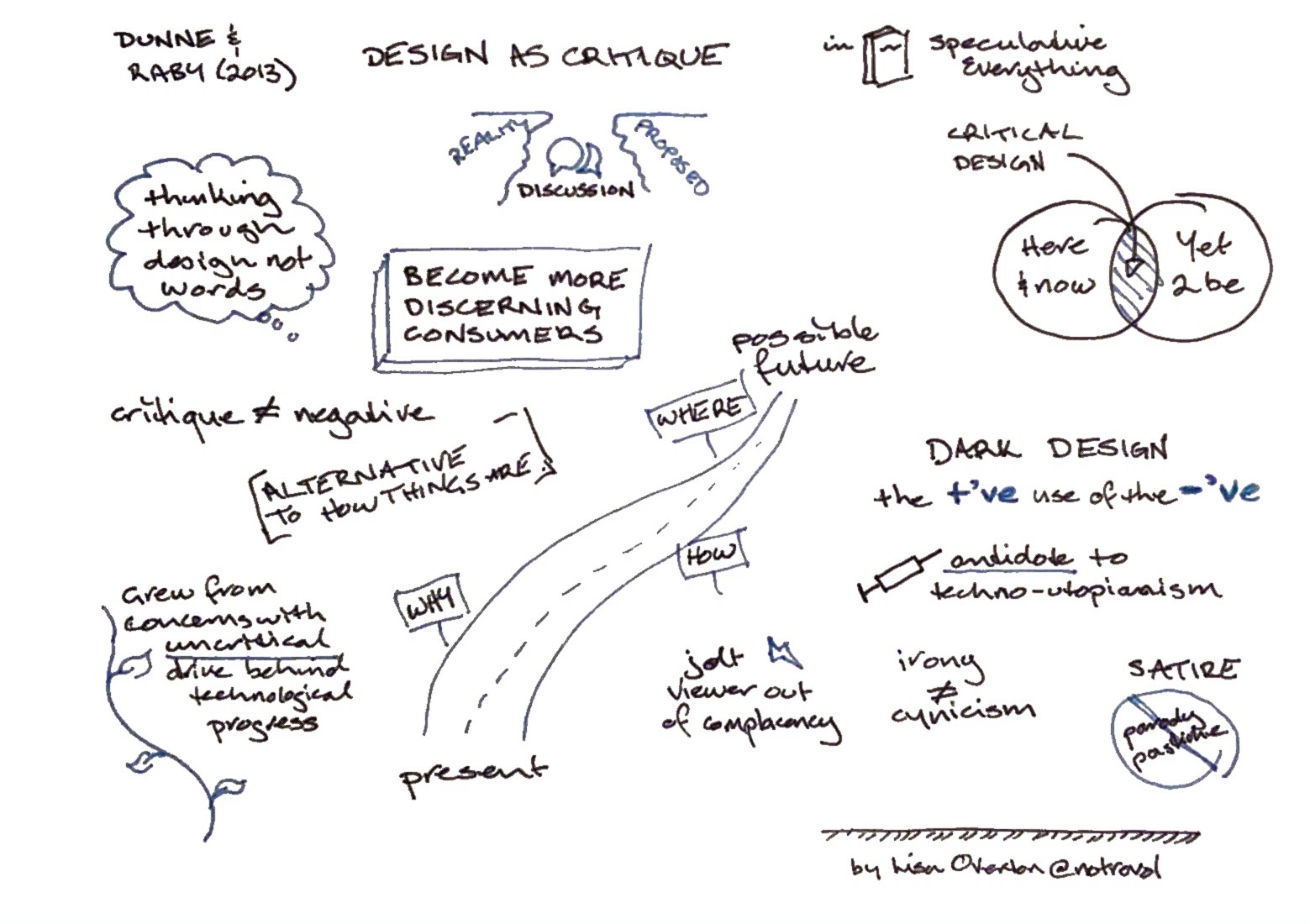
Clearly in their consideration of complex socio-cultural issues, Dunne & Raby offer up critical design as “serving as a bridge the main track and the side track” as de Bono would put it. That they build on this to promote critical design as a tool for thinking offers us path to action when we arrive on the side track.
For those of you interested in The Logic of Provocation you can read more about it in this piece from de Bono on Serious Creativity.
This post was generated as part of RMIT University’s Masters of Design Futures program, you can find out more at http://designfuture.me/
 Lisa blogs here